How many calories are in Kaiserschmarrn?
A plate of Kaiserschmarrn, about 220 g of torn, fried pancake with a bowl of apple sauce, comes to about 610 kcal. The Schmarrn is 550 of that. The fruit alongside is the small part: BLS puts plum compote, the base of a Zwetschgenröster, at 66 kcal per 100 g against 59 for apple sauce.
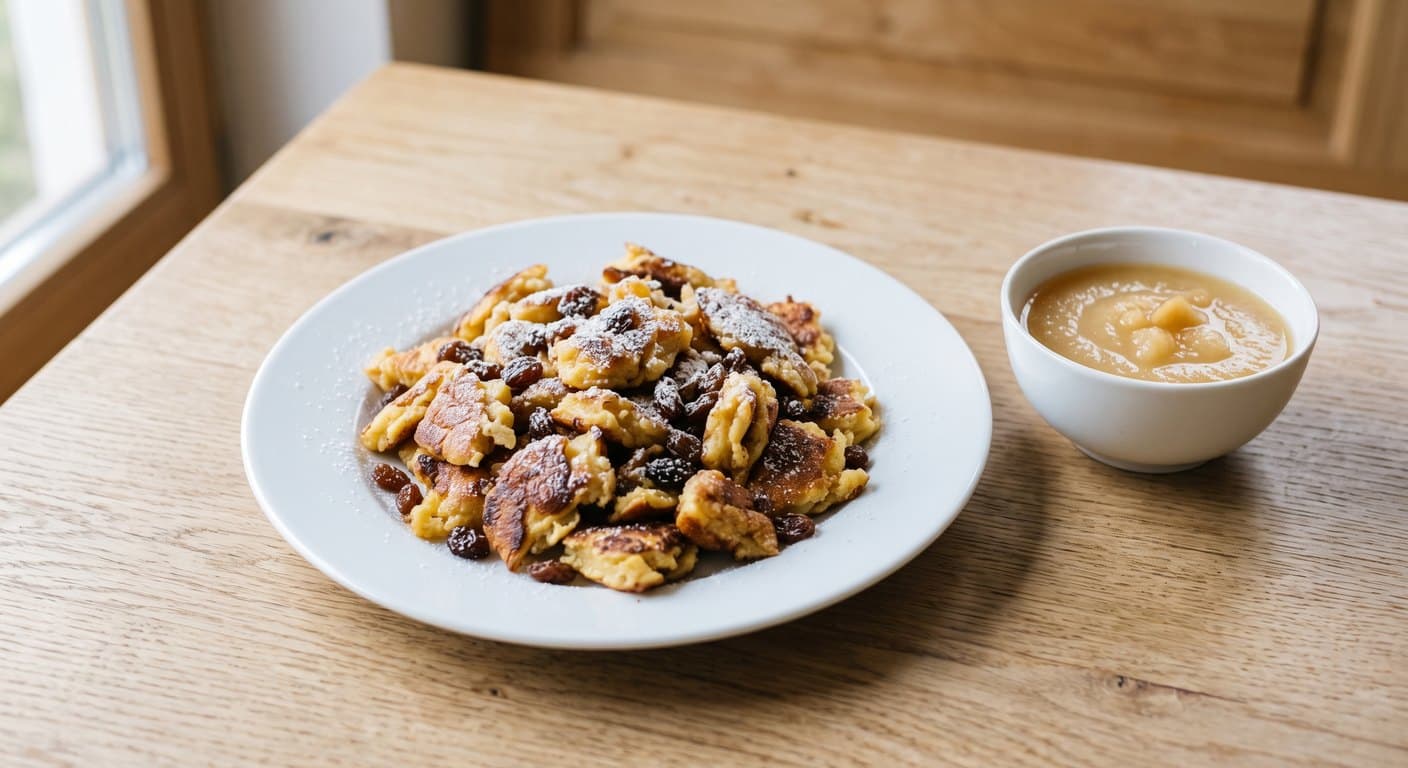
The plate, as served
About 220 g of Kaiserschmarrn made with whole milk, with about 100 g of apple sauce. Icing sugar not counted.
Where the calories come from
| Nutrient | Grams | Calories | Share |
|---|---|---|---|
| Protein | 18g | 72 | 12% |
| Carbs | 64g | 256 | 43% |
| Fat | 29g | 261 | 44% |
| Fibre | 5g | counted within carbs | |
The ring is sized by calories, not grams: protein and carbs are 4 kcal a gram, fat is 9. Drawn by grams, fat would look like a sliver of what it actually contributes.
What is on the plate
| KaiserschmarrnA plate, about 220 g | 550 kcal |
| Apple sauceA small bowl, about 100 g | 60 kcal |
The same dish, several ways
This is where the calories actually move. Not the ingredient, the cooking.
- With extra butter in the pan685+75
Another 10 g of butter at the end is 75 kcal.
- About 220 g of Kaiserschmarrn made with whole milk, with about 100 g of apple sauce. Icing sugar not counted.As served610
- Without apple sauce550-60
The Schmarrn on its own, 550 kcal.
Where each number comes from
Composition tables list ingredients, not dinners. There is no row anywhere for this plate, so it is built from its parts, and the preparation assumed for each part is written next to it, because that assumption is usually worth more calories than the ingredient.
| Component | Portion and preparation | kcal |
|---|---|---|
| Kaiserschmarrn | A plate, about 220 gBLS Y890342 (Kaiserschmarren (mit Milch 3,5 % Fett) gebraten). Thick pancake batter with whole milk, fried and torn into pieces. Icing sugar on top is not included. | 550 |
| Apple sauce | A small bowl, about 100 gBLS Y843143 (Apfelmus). Sweetened apple sauce. Unsweetened is 51 kcal per 100 g against 59 (BLS Y864112). | 60 |
| Total | 610 | |
Sources: German Nutrient Database BLS 4.0 (Max Rubner-Institut), CC BY 4.0. Every figure is an estimate with a range around it, and is rounded to the nearest 5 kcal rather than pretending to a precision that does not exist.
Why you will see 477 to 810 kcal quoted for this
Supermarket recipes and ready meals from Lidl and REWE land at 477 to 578 kcal a portion. Arise lists 600 to 810 with Zwetschgenröster. The gap is mostly the size of the plate, since restaurant portions run larger than recipe ones, and a Röster cooked down with sugar is denser than the plum compote in BLS.
Which is why this page shows the sum instead of asserting a total. Build the plate you actually eat and the number is yours rather than an average of strangers.
Build your own plateCommon questions
- How many calories are in Kaiserschmarrn?
- About 610 kcal for a 220 g plate with apple sauce, and 550 without.
- Apple sauce or Zwetschgenröster, which is lighter?
- They are close. BLS has 59 kcal per 100 g for apple sauce and 66 for plum compote. A Röster cooked down with extra sugar sits higher.
- Is Kaiserschmarrn a main course or a dessert?
- Both. In Austria and Bavaria it is often eaten as a sweet main, and at about 610 kcal it is the size of one.
- How do I make Kaiserschmarrn lighter?
- Use less butter in the pan and skip the icing sugar. The batter is eggs, milk and flour, and the frying fat is where it climbs.
Point the camera at anything.
The coach reads the plate rather than the packet, and it plans around the food you have told it you will never give up.

Other plates
The coach knows this dish, and every other you eat. It works in any cuisine, and in none of them exclusively.